



31-Point Google Business Profile Optimization Checklist
Use this practical checklist to improve the accuracy, relevance, trust, and conversion readiness of a Google Business Profile.
Start with the profile details that affect visibility and customer action first, then use the monthly audit to keep the listing clean.
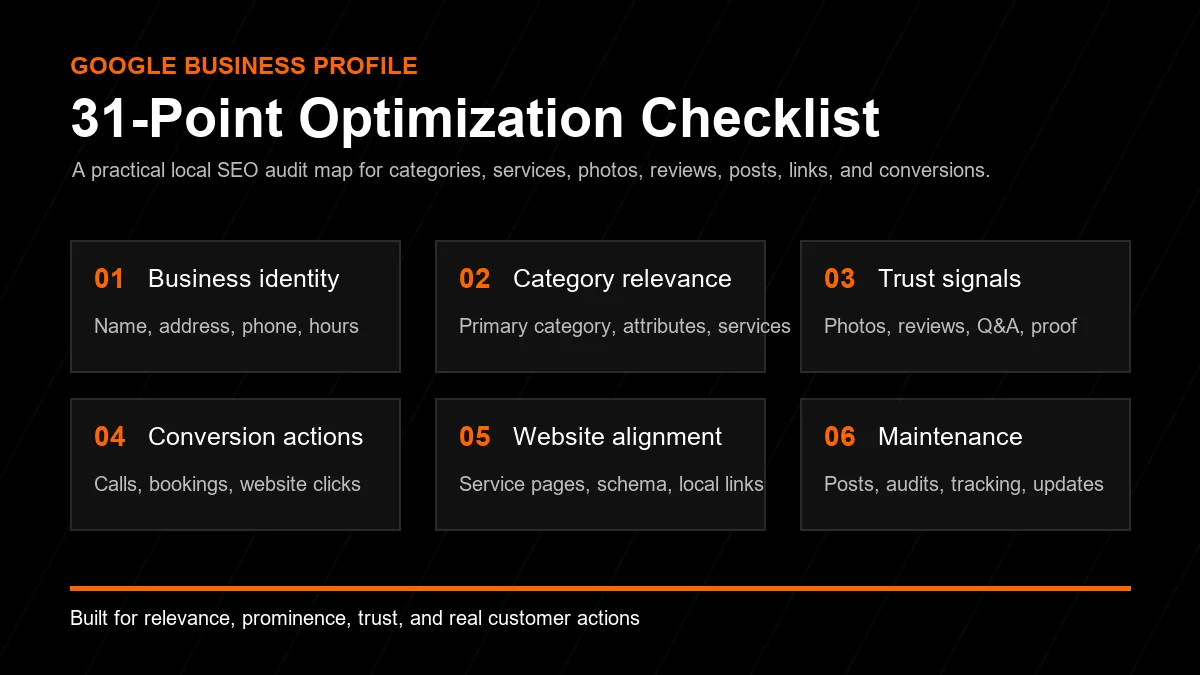
A visual map of the profile areas that influence local visibility, trust, and customer action on Google Search and Maps.
How To Use This Checklist
This checklist is written for business owners, local SEO consultants, and service providers who want a practical way to improve a Google Business Profile without keyword stuffing or duplicate location pages.
Work through the foundation items first, then improve services, photos, reviews, landing pages, tracking, and monthly maintenance.
What Should Be Optimized First In GBP?
Tier 1 – Foundation Fixes
Fix verification, business name, primary category, address or service area, phone number, website URL, opening hours, and core services before anything else.
Tier 2 – Relevance And Conversion
Improve secondary categories, service descriptions, business description, products, appointment links, photos, Q&A, posts, and page alignment.
Tier 3 – Authority And Maintenance
Build review velocity, citation consistency, local backlinks, schema, competitor monitoring, UTM tracking, audits, and content expansion over time.
1. Foundation And Identity
Confirm eligibility and ownership
Only create or manage a profile for a real business that meets Google eligibility rules. Verify it through the available method before relying on profile features.
This protects the listing from avoidable suspension issues and gives the business owner full access to calls, messages, photos, reviews, and profile edits.
Use the real-world business name
Use the name customers see on signage, legal documents, and daily customer communication. Do not add cities, services, slogans, or keywords to it.
A clean business name keeps the profile policy-safe and builds trust because the name matches what customers already recognize offline and online.
Set the right address or service area
Storefront businesses should show an accurate customer-facing address. Service-area businesses should define the areas they actually serve and avoid a false office location.
This improves local relevance without creating location confusion for customers who need directions, service coverage, or delivery expectations.
Add a working phone number
Use a local or direct business number that customers can reach during opening hours. Make sure the same core number is used consistently on the website.
This helps convert ready-to-call searchers and reduces friction when someone finds the business from Google Search or Maps.
Keep regular and special hours current
Update ordinary hours, holiday closures, seasonal hours, and emergency availability before customers see incorrect information in Search or Maps.
Accurate hours protect customer trust and can increase calls, bookings, visits, and direction requests during high-intent search moments.
Use the right website URL
Link the profile to the best page for the user intent. A single-location business can link to the homepage, while a multi-location brand often needs a matching location page.
A better landing page improves conversion because the visitor sees the same service, city, phone number, proof, and call-to-action they expected from the profile.
2. Categories, Services, And Relevance
Choose a precise primary category
Pick the category that best describes the main revenue-generating service. A dentist should usually use Dentist, while an emergency dentist page can support the emergency intent on the website.
The primary category is one of the strongest relevance signals inside the profile, so precision helps Google understand when the listing deserves to appear.
Add secondary categories carefully
Use secondary categories only when the business genuinely offers those services. Avoid adding every related category just because competitors use it.
Careful category expansion can improve visibility for related searches while keeping the profile focused and trustworthy.
Fill out services with clear descriptions
Add core services with short descriptions that explain what is offered, who it is for, and when customers need it. Keep the language natural and service-specific.
This improves Google Business Profile SEO optimization because the profile gives stronger topical signals for local service searches.
Write a business description around real offers
Use the business description to explain the main services, customer type, service area, and proof points. Avoid repeating the keyword in every sentence.
A useful description helps customers qualify the business quickly and supports semantic relevance without keyword stuffing.
Add products or menus when the model supports them
Restaurants should keep menus accurate, dentists can highlight treatments, and contractors can present estimate-based services as products when suitable.
This gives searchers more decision information before they visit the website and can lift clicks, calls, bookings, and orders.
Complete attributes that match customer intent
Add relevant attributes such as accessibility, online appointments, emergency availability, women-owned, payment options, or service options when they are accurate.
Attributes answer practical questions fast and help the listing match more specific customer needs.
Add booking, appointment, or quote links
Use appointment links, reservation links, quote links, ordering links, or contact forms where they fit the business model. Test the links on mobile.
This reduces the number of steps between profile discovery and lead action, especially for users who do not want to browse the full website first.
Match profile services to landing pages
Connect GBP services to website pages that explain the same offer. A plumber with water heater repair on the profile should have a useful water heater repair page.
This alignment strengthens relevance across the profile and website, and it gives customers a stronger path from discovery to enquiry.
Want Me To Optimize Your Google Business Profile?
I can audit your categories, services, reviews, photos, local landing pages, and conversion path so your profile is built for calls and enquiries.
3. Photos, Posts, Reviews, And Engagement
Upload real photos by intent type
Use exterior photos, interior photos, staff photos, service photos, before-and-after photos, project photos, and product photos depending on the business type.
Real photos improve trust, help customers recognize the business, and support Google Business Profile photo optimization in a natural way.
Refresh videos and work samples
Add short videos that show the team, equipment, finished work, service process, or customer experience. Keep them real and easy to understand.
Fresh visual proof can reduce hesitation because customers see evidence before they call, book, or request a quote.
Publish posts for updates, offers, and trust
Use posts for announcements, offers, seasonal services, case examples, events, and helpful updates. Avoid posting thin AI-generated text that says nothing new.
Posts keep the profile active and give customers more reasons to choose the business when comparing local options.
Seed and monitor the Q&A section
Add genuine frequently asked questions that customers ask before buying. Monitor public answers so incorrect information does not sit on the profile.
A strong Q&A section removes objections before they become lost leads, especially around pricing, availability, booking, service areas, and guarantees.
Build a repeatable review request process
Ask real customers for reviews after a completed job, appointment, meal, purchase, or service experience. Make the request simple and policy-safe.
Review velocity and quality support prominence and trust, while fresh reviews help customers feel the business is active and reliable.
Respond to reviews with local context
Reply to reviews professionally and mention real service context when it fits naturally. Do not reveal private information or repeat the same reply every time.
Thoughtful review responses show customer care and add useful context for searchers comparing similar businesses.
Use review themes to improve conversions
Look for repeated words in reviews such as fast, clean, honest, emergency, gentle, affordable, friendly, or professional. Use those themes on service pages and CTAs.
Customer language helps the profile and website speak to real buying concerns instead of generic marketing claims.
4. Website, Authority, And Local SEO Alignment
Create strong local landing pages
Build location or service-area pages only when they have real value, unique proof, and a clear reason to exist. Do not create duplicate city pages with swapped names.
Good local landing pages help the profile convert and support organic rankings for services the business wants to sell.
Keep NAP and citations consistent
Make sure the business name, address, phone number, website, and categories are consistent across important directories and local listings.
Citation consistency reduces confusion and supports confidence in the business details Google and customers see across the web.
Add local business schema and FAQ schema
Use LocalBusiness schema, service schema, and FAQ schema where relevant on the website. Keep the schema aligned with visible page content.
Schema helps search engines understand the entity, services, location, contact information, and common questions connected to the business.
Earn local links and mentions
Build real local authority through sponsorships, chambers, suppliers, partners, community organizations, local PR, and niche industry mentions.
Local links and brand mentions improve prominence and make the business look more established in its market.
Align city and niche pages with GBP services
If the profile lists roofing repair, dental implants, HVAC repair, or restaurant catering, the website should have matching useful pages where those services matter.
This helps the website and profile reinforce the same service entities, customer intent, and location relevance.
Review competitors for proof and feature gaps
Compare top competitors for categories, reviews, photos, services, posts, Q&A, landing pages, and conversion paths. Do not copy blindly.
Competitor review helps you find practical gaps such as missing photos, weak service pages, unclear CTAs, or poor proof.
5. Tracking, Maintenance, And Ongoing Improvement
Add UTM tracking to website links
Use UTM parameters on the website link, appointment link, and campaign links so GBP traffic can be separated in analytics.
Tracking shows which profile actions create website visits, calls, bookings, forms, and enquiries.
Review GBP insights every month
Check calls, website clicks, direction requests, bookings, messages, profile views, search terms, and photo performance every month.
Monthly review turns optimization into decisions instead of guesswork and shows what needs attention next.
Audit duplicates, spam, and policy risks
Look for duplicate listings, wrong addresses, keyword-stuffed names, fake listings, old phone numbers, and competitor spam in the local market.
Cleaning profile risks protects rankings, trust, and conversion while making the local SERP more accurate.
Run a monthly checklist and refresh weak areas
Recheck categories, services, reviews, photos, posts, Q&A, hours, links, citations, landing pages, and tracking every month.
Consistent maintenance helps the profile keep improving instead of becoming outdated after one setup project.
Download The GBP Optimization Checklist Template
Download the tracker, choose a status for each task, and use it as your monthly GBP audit sheet to keep optimization work organized.
Download Excel TemplateGBP Optimization Checklist By Business Type
Roofers And Contractors GBP Optimization
Prioritize project photos, service-area pages, storm damage or emergency service pages, review language, warranty details, and quote request CTAs. Connect GBP services to roof repair, roof replacement, remodeling, extensions, and emergency repair pages where relevant.
HVAC And Plumbing GBP Optimization
Focus on emergency intent, availability, service categories, technician trust, vehicle photos, equipment photos, completed work, fast call actions, and reviews that mention speed, cleanliness, and price clarity.
Dentists And Clinics GBP Optimization
Use practitioner trust, treatment pages, appointment links, clinic photos, accessibility attributes, emergency availability, insurance information, and privacy-safe review responses.
Restaurants And Food Businesses GBP Optimization
Keep menu accuracy, food photos, reservations, opening hours, holiday hours, attributes, offers, popular dishes, and review responses current because customers make fast visual decisions.
Cleaning Companies GBP Optimization
Show before-and-after photos, service areas, recurring cleaning options, move-out cleaning, commercial cleaning, staff trust, quote links, and reviews that mention reliability and attention to detail.
Law Firms GBP Optimization
Use practice-area relevance, attorney trust, appointment links, office photos, consultation CTAs, review quality, citation consistency, and landing pages for each real legal service.
Common GBP Optimization Mistakes
Avoid these shortcuts because they create customer confusion, policy risk, or weak conversion paths.
Adding keywords or city names to the business name.
Choosing broad or irrelevant categories.
Using stock photos instead of real business photos.
Ignoring reviews, Q&A, and holiday hours.
Creating fake city profiles or duplicate listings.
Linking the profile to weak or unrelated pages.
Forgetting service descriptions and attributes.
Tracking rankings but not calls, bookings, or enquiries.
Why GBP Optimization Matters For Local SEO
Local search is not only about a website ranking in organic results. For many local-intent searches, people see map results, reviews, photos, call buttons, direction buttons, opening hours, and service information before they ever click a traditional website result.
Google explains local ranking through relevance, distance, and prominence. A complete profile helps relevance because Google can better understand what the business offers. Accurate location or service-area data helps distance, while reviews, links, citations, brand mentions, and broader authority help prominence.
Relevant FAQs
What should be optimized first in a Google Business Profile?
Start with verification, real business name, primary category, address or service area, phone number, website link, hours, and core services. These are the foundation for relevance and customer confidence.
Does Google Business Profile optimization improve local rankings?
It can improve local visibility when the profile becomes more complete, accurate, relevant, and trusted. Results also depend on distance, competition, reviews, links, and the wider local market.
How often should a Business Profile be updated?
Review key information monthly and update it whenever hours, services, staff, offers, locations, or customer-facing details change. Add photos, replies, and posts when there is a genuine reason to do so.
Can AI tools help optimize a Google Business Profile?
AI can help organize ideas for posts, service descriptions, and review replies. The final content still needs real business facts, policy-safe language, and human review.
Do photos matter for a Google Business Profile?
Yes. Real, clear photos help customers recognize the business, understand its services, and make a more confident decision. Keep them current and representative.
Should each niche or service have a separate landing page?
Only create a separate niche page when the service has unique search intent, examples, proof, FAQs, and conversion value. Avoid duplicate pages with the same content and swapped city or service names.
Conclusion
A strong Google Business Profile is accurate, complete, trusted, and connected to the website pages that help customers take action. Use this checklist as a working audit, not a one-time setup task.
Book GBP Optimization Help